
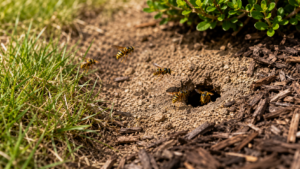
 If yellow jackets suddenly seem to be everywhere around your yard, trash cans, deck, or outdoor dining area, you are not imagining it.
Yellow jacket activity commonly increases during the second half of summer throughout Mechanicsville, Hanover, Richmond, and Central Virginia. Their colonies are larger, food sources are changing, and the insects may become much more defensive around their nests.
Understanding what is happening can help you protect your family, pets, employees, and guests without taking unnecessary risks.
WHY ARE YELLOW JACKETS MORE ACTIVE IN LATE SUMMER?
A yellow jacket colony begins relatively small in the spring. As the weather warms, the queen produces more workers, and the colony continues growing throughout the summer.
By late summer, a mature nest may contain hundreds or even thousands of yellow jackets. More workers means more insects leaving the nest to search for food and more yellow jackets defending the colony.
Their feeding habits also begin to change.
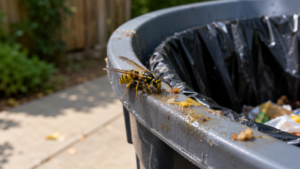
Earlier in the season, yellow jackets frequently hunt insects and other sources of protein to feed developing larvae. Later in the summer, they become increasingly attracted to sugary foods and drinks.
This is why yellow jackets commonly appear around:
• Trash and recycling containers
• Outdoor meals and cookouts
• Soda cans and sweet tea
• Fallen fruit
• Pet food
• Restaurant dumpsters
• Festival and concession areas
A single uncovered drink or food container can attract multiple yellow jackets surprisingly quickly.
WHERE DO YELLOW JACKETS BUILD THEIR NESTS?
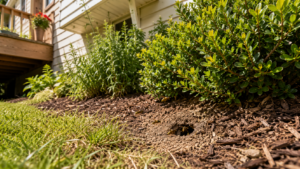 Many yellow jacket nests are hidden, making them difficult to notice until the colony has become well established.
Common nesting locations include:
• Abandoned rodent burrows
• Holes in the ground
• Landscape beds
• Areas beneath shrubs
• Wall voids
• Attics and soffits
• Sheds and outbuildings
• Openings around siding
• Spaces beneath decks or porches
Ground nests can be especially dangerous because homeowners may accidentally disturb them while mowing, trimming shrubs, pulling weeds, or allowing children and pets to play nearby.
One of the clearest signs of a nest is a steady stream of insects entering and leaving the same opening.
ARE YELLOW JACKETS THE SAME AS BEES?
Yellow jackets are wasps, not bees.
They usually have smooth, brightly marked yellow-and-black bodies and a more defined waist. Unlike honeybees, yellow jackets can sting repeatedly.
They are beneficial predators because they feed on many other insects. However, a nest located near a doorway, walkway, playground, deck, business entrance, or frequently used portion of the yard can create a serious safety concern.
WHY DO YELLOW JACKETS BECOME AGGRESSIVE?
 Yellow jackets do not always attack without reason, but they are highly defensive of their nesting area.
Vibrations from lawn equipment, footsteps near an underground nest, landscaping work, or attempts to block the nest opening may trigger defensive behavior. Once the colony senses a threat, multiple yellow jackets may respond.
They can also become persistent around food and drinks during late summer. Swatting at them or attempting to crush one near the nest may increase the danger.
The safest response is to move calmly away from the area and avoid disturbing the nest.
SHOULD YOU TREAT A YELLOW JACKET NEST YOURSELF?
Spraying the insects that you see flying around will not necessarily eliminate the colony. The majority of the yellow jackets may remain protected inside the nest.
Attempting a do-it-yourself treatment can also be risky when:
• The nest entrance is difficult to see
• The colony is inside a wall
• The nest is close to a doorway or walkway
• The insects are entering through siding or roofing
• Someone nearby is allergic to stings
• The nest is underground
• The colony has already become defensive
Never seal an active wall opening without first addressing the colony. Yellow jackets trapped inside a structure may search for another exit and sometimes enter the living space.
Pouring gasoline, bleach, boiling water, or other household chemicals into a ground nest is also unsafe and may contaminate the soil without eliminating the entire colony.
WHAT SHOULD YOU DO AFTER FINDING A NEST?
Keep children and pets away from the area and stop mowing, trimming, or performing other work near the nest.
Try to identify the entrance from a safe distance, but do not stand directly in the insects’ flight path. Avoid striking the nest, blocking the opening, or spraying it while people are nearby.
When the nest is located near an occupied area, professional inspection and treatment are generally the safest options.
PREVENTING YELLOW JACKET PROBLEMS AROUND YOUR PROPERTY
Although it is impossible to prevent every yellow jacket from entering your yard, several steps can make the property less attractive:
• Keep outdoor trash containers tightly closed
• Rinse food residue from recycling containers
• Clean spills from patios, decks, and outdoor tables
• Avoid leaving pet food outdoors
• Pick up fallen fruit
• Inspect soffits, siding, and exterior openings
• Cover drinks when eating outside
• Check cans and bottles before taking a sip
• Keep food covered during cookouts and outdoor events
Commercial properties, restaurants, parks, community organizations, and outdoor event locations should pay particular attention to dumpsters, trash cans, concession areas, and beverage stations.
THE ALL-STARS APPROACH TO YELLOW JACKET CONTROL
At All-Stars Pest Control, our goal is to solve the problem without selling fear.
We begin by identifying the insect, locating the nest whenever possible, and determining whether it is in the ground, inside a structure, or attached to the exterior. We then recommend an appropriate treatment based on the nest location and the conditions surrounding the property.
Clear communication is especially important with stinging insects. We explain what we find, how the treatment works, and what activity you may notice afterward.
YELLOW JACKET CONTROL IN CENTRAL VIRGINIA
All-Stars Pest Control is a family-owned pest control company serving Mechanicsville, Hanover, Richmond, Glen Allen, Ashland, Chesterfield, and surrounding Central Virginia communities.
If yellow jackets are nesting near your home, business, deck, entrance, or outdoor gathering area, do not put yourself or your family at unnecessary risk.
Contact All-Stars Pest Control to schedule an inspection and receive trusted advice, clear communication, and a practical solution for your property.