
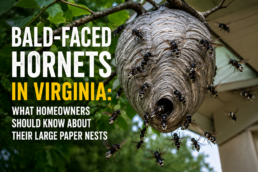
Bald-Faced Hornets in Virginia: What Homeowners Should Know About Their Large Paper Nests
A large gray paper nest hanging from a tree, shrub, porch, or roofline can be an alarming discovery.
These enclosed nests are often built by bald-faced hornets, a common stinging insect found throughout Virginia. Although they are frequently called hornets, bald-faced hornets are actually a type of aerial yellow jacket.
Their colonies may remain unnoticed early in the season because the nest begins small and is often hidden by leaves. As summer progresses, the nest and colony continue growing, making activity much easier to see.
What Does a Bald-Faced Hornet Look Like?
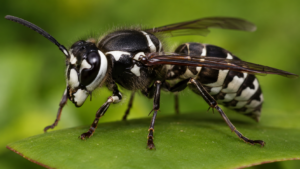 Bald-faced hornets have a distinctive appearance that separates them from the familiar yellow-and-black coloring of most yellow jackets.
They are primarily black with ivory-white markings on the:
• Face
• Thorax
• Legs
• End of the abdomen
Their mostly white face is responsible for the name “bald-faced hornet.”
Adult workers are typically larger than many common yellow jackets. Their dark coloring and size can make them appear intimidating, especially when several are flying around a nest.
What Does Their Nest Look Like?
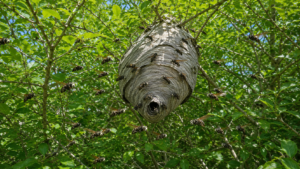
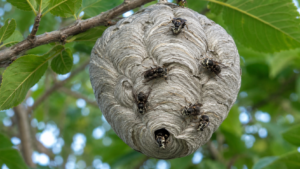 Bald-faced hornets build large, enclosed paper nests with a rounded, oval, or football-like shape.
The exterior usually has swirling layers of gray and tan paper. The insects create this material by chewing weathered wood fibers and mixing them with saliva.
Unlike the exposed, umbrella-shaped nests made by paper wasps, a bald-faced hornet nest has an outer paper covering that protects the internal combs.
The nest normally has one entrance near the bottom. Workers regularly enter and leave through this opening, and several hornets may remain nearby to guard it.
Where Do Bald-Faced Hornets Build Their Nests?
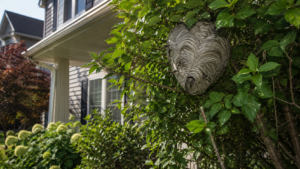 Bald-faced hornets generally build aerial nests above the ground.
Common nesting locations include:
• Trees
• Dense shrubs
• Beneath roof overhangs
• Porch ceilings
• Around sheds and outbuildings
• Utility poles
• Beneath decks
• Around windows
• Building exteriors
Nests may be built several feet above the ground, but they can also appear in low shrubs or landscaping where homeowners, children, pets, or landscaping crews may accidentally get too close.
A nest surrounded by summer foliage can be surprisingly difficult to notice until leaves are trimmed or activity increases.
Are Bald-Faced Hornets Aggressive?
 Bald-faced hornets are predators that feed on flies, other insects, and sometimes other yellow jackets. Away from the nest, an individual hornet may not cause a problem.
However, the colony can become highly defensive when the nest is approached, shaken, struck, or otherwise disturbed.
Common activities that may trigger a defensive response include:
• Trimming trees or shrubs
• Mowing near a low nest
• Using ladders nearby
• Pressure washing
• Construction or roofing work
• Children playing close to the nest
• Pets moving through landscaping
• Striking the nest with a branch or tool
Unlike honeybees, bald-faced hornets can sting more than once. When the nest is threatened, multiple workers may respond.
Should Every Nest Be Removed?
Not every bald-faced hornet nest requires immediate treatment.
A nest located high in a tree and far away from regular human activity may be left alone in some situations. Bald-faced hornets provide ecological benefits by feeding on flies and other insects.
However, removal should be considered when the nest is:
• Near a doorway or walkway
• Close to a deck, porch, or patio
• In a frequently used portion of the yard
• Near children or pets
• Around a business entrance
• Close to landscaping or maintenance work
• Low enough to be disturbed accidentally
• Near someone with a known sting allergy
The nest’s location and the likelihood of contact are generally more important than its appearance alone.
Why You Should Not Knock Down an Active Nest
Attempting to knock down, cut, spray, burn, or strike an active nest can provoke a rapid defensive response.
Even when only a few hornets are visible outside, many more may be protected inside the nest.
Homeowners should avoid:
• Throwing objects at the nest
• Spraying it with a garden hose
• Cutting the supporting branch
• Sealing the entrance
• Burning the nest
• Standing directly underneath it
• Using a ladder near active hornets
Aerosol sprays may also require the user to stand closer than is safe, especially when the nest is large or elevated.
What Should You Do After Finding a Nest?
Keep people and pets away from the area and avoid disturbing nearby branches, shrubs, siding, or structures.
Observe the nest only from a safe distance. Look for consistent flight activity entering and leaving through an opening near the bottom.
Do not stand directly beneath the nest or block the insects’ flight path.
If the nest is located near an occupied area, contact a pest management professional for an evaluation.
Do Bald-Faced Hornets Reuse Old Nests?
Bald-faced hornet colonies are seasonal.
The workers and original queen generally die as cold weather arrives. Newly produced queens leave the nest, mate, and spend the winter protected in sheltered locations.
The old paper nest is not normally reused the following year. However, a new queen may build another nest elsewhere on the same property if suitable conditions are available.
An abandoned nest may gradually deteriorate from weather, birds, and other wildlife.
Preventing Problems Around Your Property
It is difficult to prevent every aerial nest because queens can choose many different locations.
Regular inspections can help identify nests while they are still small.
During spring and early summer, inspect:
• Rooflines and soffits
• Porch ceilings
• Decks
• Sheds
• Trees near walkways
• Dense shrubs
• Play areas
• Frequently used portions of the yard
Trim vegetation carefully and look for repeated insect traffic before beginning landscaping work.
Keeping trash containers closed and cleaning sugary food or beverage spills may also reduce foraging activity around patios, events, and outdoor dining areas.
The All-Stars Approach to Bald-Faced Hornet Control
At All-Stars Pest Control, we begin by correctly identifying the insect and evaluating the location of the nest.
We consider:
• The height and accessibility of the nest
• The size and activity of the colony
• Nearby doors, walkways, and gathering areas
• The risk to children, pets, customers, or employees
• The safest and most practical treatment method
Our goal is to provide straightforward recommendations without using fear to sell unnecessary services.
Bald-Faced Hornet Control in Central Virginia
All-Stars Pest Control is a family-owned pest control company serving Mechanicsville, Hanover, Richmond, Glen Allen, Ashland, Chesterfield, and surrounding Central Virginia communities.
If you discover a large paper nest near your home, business, deck, landscaping, or entrance, avoid disturbing it.
Contact All-Stars Pest Control for proper identification, practical advice, and professional treatment when needed.
